
Gdańsk (guh-DANYSK) is Poland’s Baltic coast city, and it has a completely different energy from Kraków or Warsaw. Where those cities are inland and landlocked, Gdańsk smells like salt air, looks like Amsterdam’s taller, more colourful cousin, and moves at a pace that slows down the closer you get to the water. The waterfront along the Motława River is lined with tall, narrow merchant houses painted in amber, green, and terracotta — built on centuries of wealth from the amber and grain trades when this was one of the richest ports in the Hanseatic League.
It’s also the city where communism began to fall. The Solidarity movement started in the Gdańsk Shipyard in 1980, and the European Solidarity Centre — one of the best museums in Poland — tells that story in a building designed to look like a rusting ship’s hull, right where Lech Wałęsa led the strikes. Gdańsk gives you layers: medieval trading wealth, WWII destruction and reconstruction, Cold War resistance, and a modern city that now draws 3 million visitors a year without losing its identity.
If you’re coming from the UK, Gdańsk is also one of the easiest and cheapest Polish cities to reach — budget flights from London take about 2 hours 15 minutes and regularly go for under £40 return. Pair it with Sopot and Gdynia (the Trójmiasto — Tri-City — connected by commuter train) and you’ve got beach, history, food, and nightlife all in one stretch of coastline.
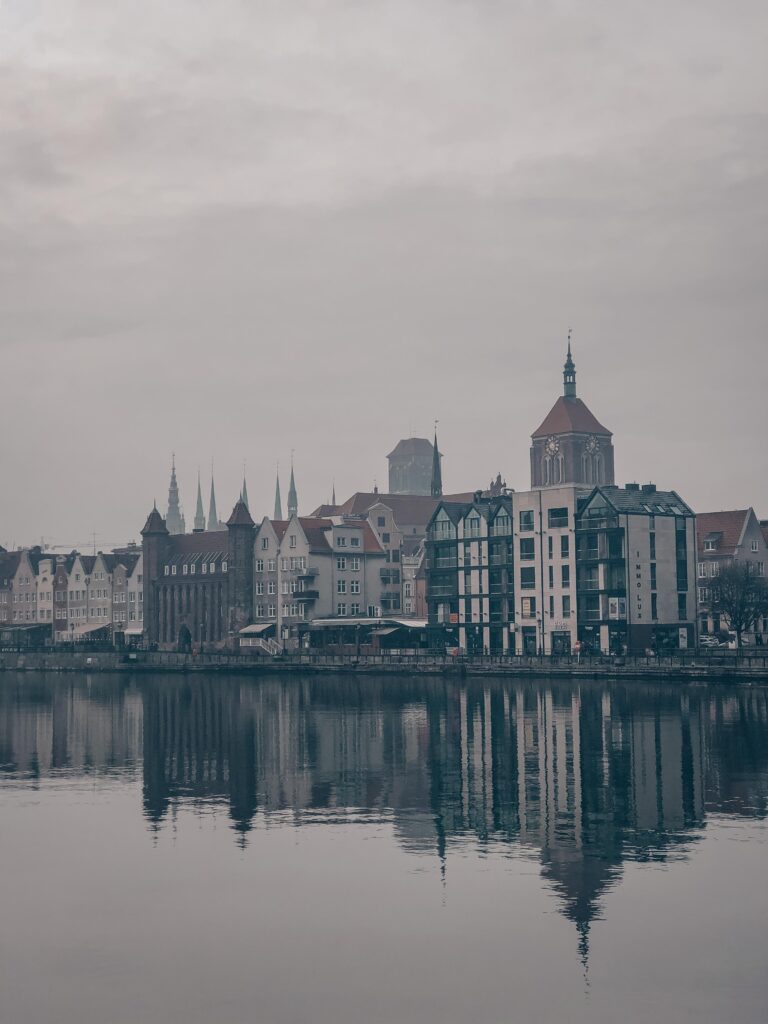
Table of Contents
Where is Gdańsk?
Gdańsk sits on the southern coast of the Baltic Sea in northern Poland, at the mouth of the Motława River where it feeds into the Dead Vistula (Martwa Wisła). It’s about 340 km north of Warsaw (roughly 3 hours by express train) and 560 km north of Kraków (5–6 hours by rail, or a 1-hour flight). The city is part of the Trójmiasto metropolitan area alongside Sopot (a beach resort town, 12 km north) and Gdynia (a port city, 20 km north), all connected by the SKM commuter rail line in under 30 minutes.
Gdańsk is in the Pomerania (Pomorze) region. The landscape here is flat Baltic lowlands — forests, dunes, and long sandy beaches stretching in both directions along the coast. If you’re combining Gdańsk with Malbork Castle (the largest brick castle in the world), it’s a 30-minute train ride south.
How to get to Gdańsk?
✈️ Flights to Gdańsk from the USA
There are no direct flights from the US to Gdańsk. Your best options are connecting through a European hub. Lufthansa (via Frankfurt or Munich), KLM (via Amsterdam), and Scandinavian Airlines (via Copenhagen) all offer competitive one-stop routings. Round-trip fares from New York typically range from $350–550 depending on season and how far ahead you book.
From Chicago, SAS and Lufthansa are usually the most efficient connections.
The alternative — and sometimes cheaper — route is to fly direct to Warsaw on LOT Polish Airlines (direct from Chicago, New York JFK, or connecting via Warsaw from other US cities), then take a PKP Intercity express train from Warsaw to Gdańsk. The train takes about 2 hours 45 minutes on the EIP Pendolino service and costs 80–150 PLN (~$20–37) booked in advance at intercity.pl. This can actually work out faster door-to-door than a connection through Frankfurt with a long layover.
✈️ Flights to Gdańsk from the UK
Gdańsk is extremely well served from the UK. Direct flights operate from London Stansted (Ryanair), London Luton (Wizz Air), London Gatwick (Jet2), Manchester (Jet2, Ryanair), Edinburgh (Ryanair), Bristol (Ryanair), Leeds/Bradford (Ryanair), Birmingham (Jet2), Newcastle (Jet2, Ryanair), and Aberdeen (Wizz Air). Belfast International is getting a new Ryanair route in 2026.
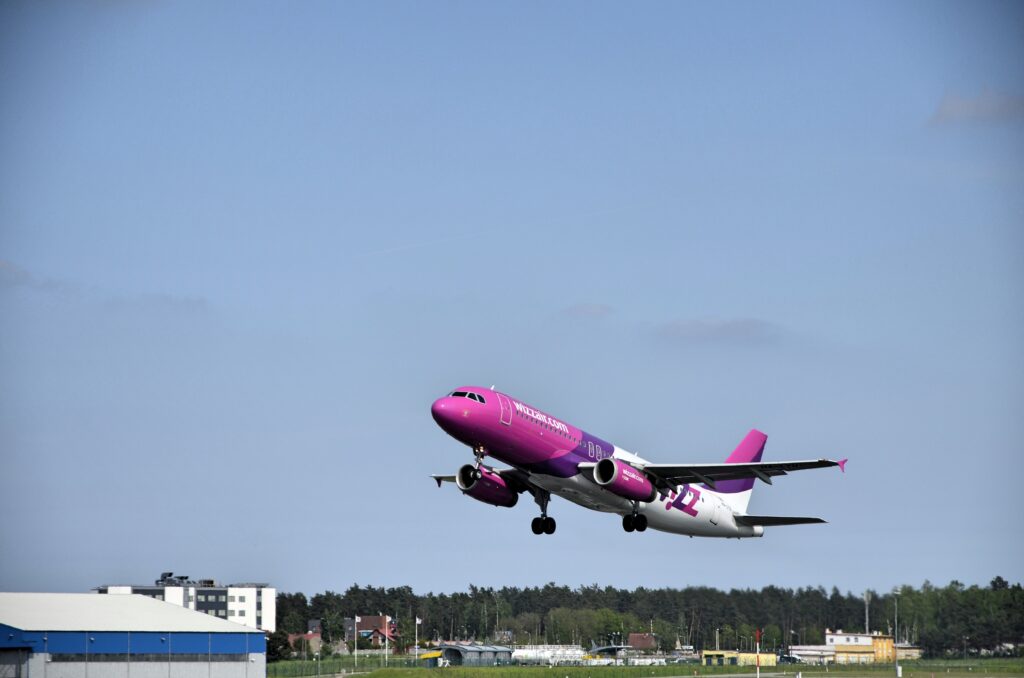
Between all carriers, there are dozens of direct flights per week from the UK. Return fares with budget airlines start as low as £30–60 if you book early and travel with hand luggage only. Flight time from London is about 2 hours 15 minutes. Jet2 tends to be slightly pricier but includes a checked bag in the fare, which can make it competitive if you’re not travelling light.
All flights land at Gdańsk Lech Wałęsa Airport (GDN), about 12 km northwest of the Old Town. A bus (route 210) runs to the city centre in about 30–40 minutes for 5 PLN (~$1.25/€1.15/£1). Taxis cost 60–80 PLN (~$15–20/€14–19/£12–16). Bolt and Uber work from the airport and are usually cheaper than traditional taxis.
🚆 Trains to Gdańsk
From Warsaw, PKP Intercity runs frequent express trains. The EIP Pendolino is the fastest at about 2 hours 45 minutes, with fares starting around 80 PLN (~$20) if booked in advance. Standard IC trains take 3–3.5 hours. Trains run roughly every hour during peak times.
From Kraków, direct trains take about 5.5–6 hours. There are a few direct services per day; otherwise, change in Warsaw. If you’re coming from Wrocław, expect about 4.5–5 hours with one change.
From Berlin, there are EuroCity trains via Poznań that take about 6 hours. This is a good option if you’re combining Germany and northern Poland.
Gdańsk Główny (main station) is centrally located, about a 15-minute walk from the Long Market (Długi Targ) in the historic centre. Book trains at intercity.pl — the site works in English and e-tickets are accepted on your phone.
Where to sleep in Gdańsk?
The Main Town (Główne Miasto) is where most visitors stay, and for good reason — you’re walking distance from everything on the tourist map. The trade-off is noise, especially on weekends in summer when the waterfront bars are packed. Expect 300–550 PLN (~$75–137/€70–129/£61–112) per night for a decent mid-range hotel.
For something quieter, look at Oliwa — a residential district to the north with its own cathedral (famous for the organ concerts) and a large park. It’s about 20 minutes to the centre by tram or SKM train. Prices drop 20–30% compared to the Main Town.
Wrzeszcz (VZHESHCH — yes, really) is the university district between the centre and Oliwa. It has good restaurants, a local feel, and lower prices than the tourist core. A solid middle ground.
Budget hostels in the Main Town run 60–120 PLN (~$15–30) per night for a dorm bed. Apartments on Airbnb or Booking are often the best value for couples: 200–350 PLN per night gets you a well-located studio. At the luxury end, Hotel Podewils on the Motława waterfront occupies a converted Gothic granary and charges accordingly — 700+ PLN per night, but the location is hard to beat.
How to get around Gdańsk?
The Main Town is compact and walkable. From the Golden Gate at the north end to the Green Gate at the south takes about 15 minutes on foot, and most of the major sights are along that axis or within a few blocks of it.
For anything beyond the centre — Oliwa, Wrzeszcz, the Gdańsk Shipyard, or trips to Sopot and Gdynia — the SKM commuter train is your best friend. It runs frequently along the coast and connects all three Tri-City centres. A single ticket costs about 4–6 PLN depending on distance. You can buy tickets from machines at stations or use the Jakdojade app.
Trams and buses (ZTM Gdańsk) cover the rest of the city. A single ticket is 4.80 PLN (~$1.20). You can buy from machines at stops or on your phone through the Jakdojade or SkyCash apps.
Bolt and Uber are widely available and cheap. A ride from the Main Town to Oliwa runs about 20–25 PLN. You don’t need a car in Gdańsk — parking in the centre is limited and expensive, and the Tri-City public transport is reliable.
What to do in Gdańsk?
Start on Długa Street (DWOO-gah) and its continuation Długi Targ (the Long Market). This is the main axis of the old city — a wide, pedestrianised boulevard lined with tall, ornate townhouses that were rebuilt after WWII destruction. The Neptune Fountain sits in the middle of Długi Targ, in front of the Artus Court (Dwór Artusa), a 14th-century merchant meeting hall that’s now a branch of the Gdańsk History Museum (entry 18 PLN / ~$4.50/€4.25/£3.70). At the north end, the Golden Gate (Złota Brama) and the Prison Tower mark the entrance to the old Royal Way.
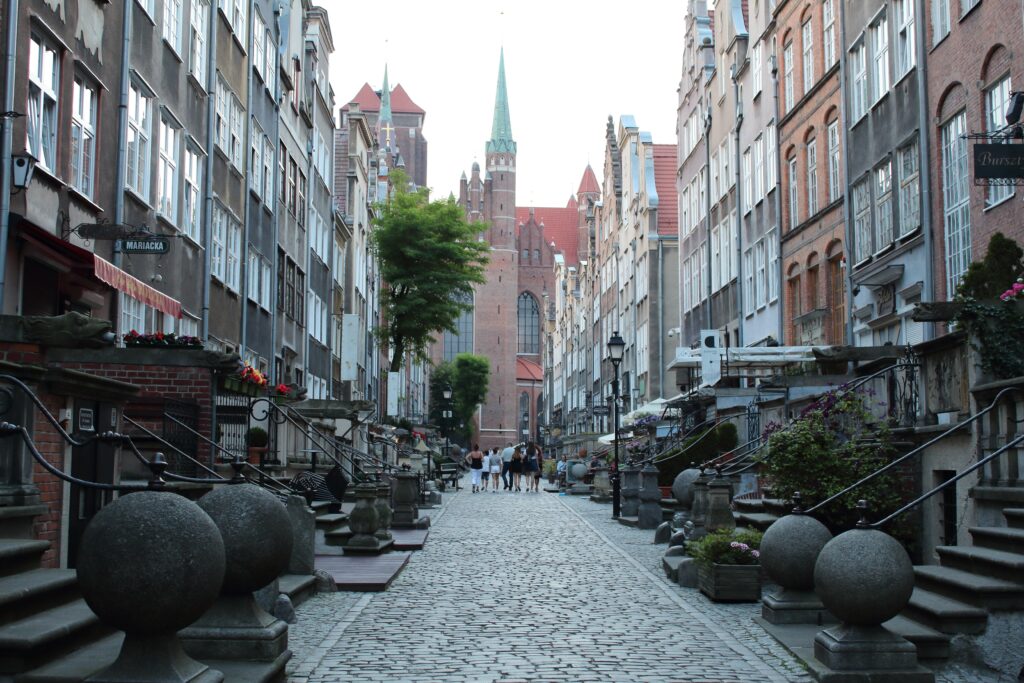
St. Mary’s Church (Bazylika Mariacka) is one of the largest brick churches in the world. The interior is massive — 105 metres long, with a vaulted ceiling that makes you feel very small. You can climb the 400+ steps of the tower for a panoramic view over the city and the Baltic (entry about 20 PLN / ~$5/€4.70/£4.10). Ulica Mariacka (St. Mary’s Street) runs along the south side of the church and is Gdańsk’s most photographed street — Gothic townhouses with stone terraces and amber shops on both sides.
The European Solidarity Centre (Europejskie Centrum Solidarności, ECS) is one of the best museums in Poland. It tells the story of the Solidarity trade union, the fall of communism, and civil resistance movements worldwide. The permanent exhibition covers the 1970 shipyard protests, the 1980 strikes, martial law, and the 1989 elections. It’s housed in a rust-coloured building designed to evoke a ship’s hull, right next to the Gdańsk Shipyard where it all happened. Entry is 35 PLN (~$8.75/€8.25/£7.15). Plan 2–3 hours minimum. Free on Wednesdays, but expect crowds.
The Museum of the Second World War (Muzeum II Wojny Światowej) opened in 2017 and takes a broad, international approach to the war — not just the Polish experience, but the global conflict. The exhibition is underground and spans 5,000 square metres. It’s well designed, emotionally heavy, and takes 2–3 hours. Entry 29 PLN (~$7.25/€6.80/£5.90). Closed Tuesdays.
Take the SKM train 20 minutes north to Sopot for the beach and Europe’s longest wooden pier (Molo, entry 10 PLN in summer). Sopot’s Monte Cassino street (the main pedestrian strip) is full of restaurants and ice cream shops, and the whole town has a different, more relaxed atmosphere than Gdańsk. In summer, the Tri-City coastline comes alive — open-air bars on the sand, concerts, and sunsets over the Baltic that last until nearly 10pm.
Oliwa Cathedral (Katedra Oliwska) is worth the trip north for the organ recitals alone. The Baroque organ has 7,896 pipes and the 20-minute concerts (held multiple times daily in summer, included with a small donation) are one of the most distinctive experiences in the Tri-City. The surrounding Oliwa Park is a good spot for a quiet walk.
Malbork Castle is a 30-minute train ride south (about 20 PLN one way). It’s the largest castle in the world by surface area — the headquarters of the Teutonic Knights, built in red brick, covering 21 hectares. A full visit takes 3–4 hours. Entry 50 PLN (~$12.50/€11.70/£10.20).
👉 Local tip: If you’re here in August, look up the St. Dominic’s Fair (Jarmark Świętego Dominika) — it’s been running for over 760 years and takes over the city centre for three weeks. Hundreds of stalls selling everything from amber to antiques to street food. It gets crowded, but it’s a genuinely good market, not a tourist setup.
What to eat in Gdańsk?
Gdańsk’s location on the Baltic means fish is a bigger part of the food culture here than in Kraków or Warsaw. Herring (śledź) shows up in multiple forms — marinated, fried, pickled, in cream sauce. Fresh cod (dorsz) and zander (sandacz) are on most restaurant menus. If you see a fish bar (bar rybny) near the waterfront, that’s where you want to be for a quick, cheap fried fish plate with chips and slaw.
For traditional Polish food, Gdańsk has its own version of the milk bar experience. Bar Mleczny Neptun, near the Main Town, serves the usual suspects — pierogi, żurek, bigos — at standard milk bar prices (15–25 PLN for a full meal). It won’t win any atmosphere awards, but the food is solid and the price is right.
At the higher end, Restauracja Kubicki on Wartka Street claims to be the oldest restaurant in Gdańsk (operating since 1918). It does Polish-Pomeranian cuisine — think roasted duck, Baltic fish dishes, and seasonal specials using local ingredients. Main courses run 50–90 PLN (~$12.50–22.50/€11.70–21/£10.20–18.40). Metamorfoza in the Old Town does modern Polish-European cooking and has been getting attention from food critics. Budget 80–120 PLN per main if you’re going for the tasting-menu approach.
For street food, the Gdańsk equivalent of Kraków’s obwarzanek is… well, there isn’t one specific iconic snack. But the fish stands near the Green Gate and along the Motława serve smoked fish (especially mackerel and eel) that’s worth stopping for. And if you see fresh-baked pączki (Polish doughnuts) in a bakery window — particularly during Fat Thursday (Tłusty Czwartek, usually in February) — get in line.
Gdańsk’s craft beer scene is also worth exploring. Browar PG4T, a local microbrewery, has a taproom near the Shipyard. Piwna Kompania in the Main Town has 20+ taps with Polish and international craft beers. A pint runs 14–22 PLN (~$3.50–5.50).
👉 Local tip: For the best fish-and-chips experience in the Tri-City, take the SKM to Gdynia and eat at one of the fish bars near the port. Less touristy than Gdańsk’s waterfront, better prices, and you can combine it with a walk along Gdynia’s waterfront promenade.
FAQ
Two to three days covers the Main Town, the European Solidarity Centre, the WWII Museum, and a day trip to Sopot or Malbork. Four days lets you explore Gdynia, Oliwa, and the beaches without rushing.
June to September for the best weather and beach access. July and August are warmest and busiest. The St. Dominic’s Fair in August is a highlight. December is worth it for the Christmas market. November and March are grey, windy, and very quiet — but cheap.
Yes, and it’s easy. Trains run frequently and take about 30 minutes. Allow 3–4 hours at the castle. You can be there and back comfortably in half a day.
Absolutely. They’re very different cities — Gdańsk is coastal, Hanseatic, and tied to the Solidarity movement and maritime history. Kraków is medieval, royal, and tied to WWII and Jewish heritage. If you have two weeks in Poland, doing both gives you two distinct sides of the country. The train between them takes about 5.5 hours, or you can fly in about an hour.
By Western European standards, no. It’s slightly pricier than Kraków in peak summer (the Tri-City is a major domestic holiday destination), but a full day of sightseeing, meals, and transport can still run under $50. Accommodation in the Main Town is the biggest cost; staying in Wrzeszcz or Oliwa saves 20–30%.