
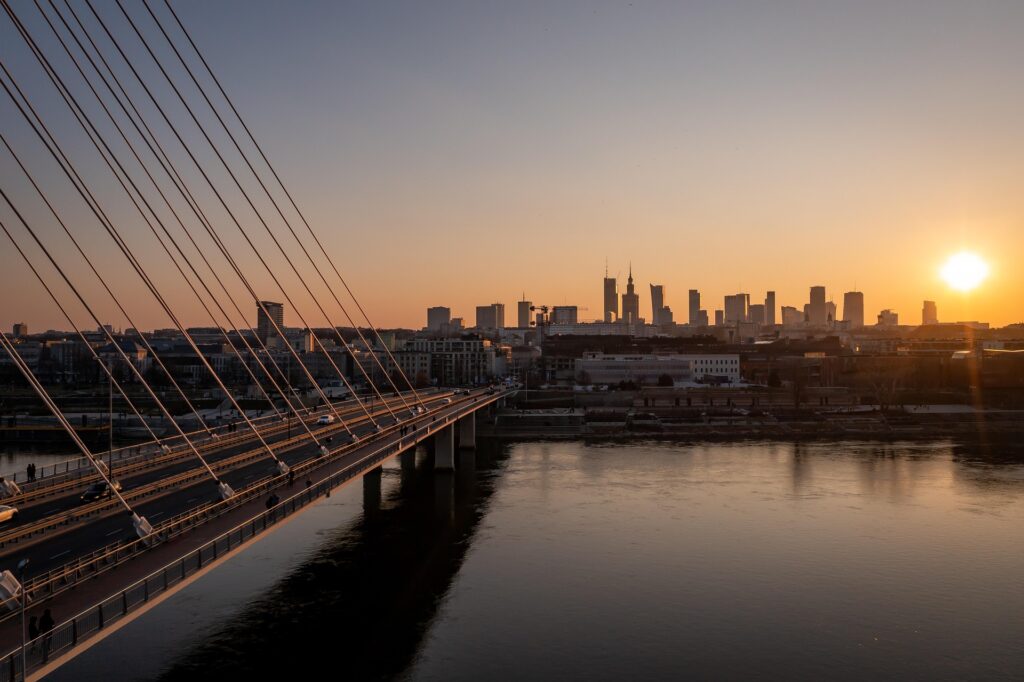
Warsaw (Warszawa, var-SHAH-vah) is Poland’s capital and biggest city, and it’s a place that constantly surprises people who come expecting grey Soviet blocks and leave thinking about going back. The city was almost destroyed during World War II and rebuilt from scratch, which gives it a strange, layered character. You get the meticulously reconstructed Old Town (a UNESCO site), Stalinist wedding-cake architecture along the main boulevards, and then a modern skyline that wouldn’t look out of place in Frankfurt. It’s messy and interesting and very much alive.
Warsaw is also the easiest Polish city to reach from the United States. If you’re flying in from the US or UK, this is probably where your trip starts.
Table of Contents
Where is Warsaw?
Warsaw sits in central-eastern Poland on the Vistula River. It’s the country’s political and financial capital, with a metro population of around 3 million. Geographically, it’s a good base for exploring the rest of Poland: Kraków is about 3 hours south by train, Gdańsk 3 hours north, and Wrocław (VROTS-wahf) about 3.5 hours southwest.
How to get to Warsaw?
Warsaw has the best international connections of any Polish city, especially if you’re coming from the US. There are two airports, a major train hub, and solid bus links to the rest of Europe.
✈️ Flights to Warsaw from the USA
LOT Polish Airlines is the only carrier operating direct flights from the US to Warsaw. As of 2026, LOT flies nonstop to Warsaw Chopin Airport (WAW) from six American cities: New York (JFK), Newark (EWR), Chicago O’Hare (ORD), Miami (MIA), Los Angeles (LAX), and San Francisco (SFO). All routes use Boeing 787 Dreamliner aircraft.
Flight times range from about 8.5 hours (from the East Coast) to around 12 hours (from LA or SF). Round-trip economy fares typically run $450–$800 depending on season and how far ahead you book. Summer and December are the priciest months. Booking 2–3 months in advance usually gets you the best deal.
If you can’t find a good direct fare, connecting through a European hub is the next best option. Lufthansa (via Frankfurt or Munich), KLM (via Amsterdam), and SAS (via Copenhagen) all offer competitive one-stop routings. These connections add 3–5 hours but can save you $100–200 on the ticket.
LOT is a Star Alliance member, so you can earn and redeem United MileagePlus, Air Canada Aeroplan, or other Star Alliance miles on these flights.
✈️ Flights to Warsaw from the UK
The UK has excellent direct connections to Warsaw, with budget carriers keeping prices very low. From London, you can fly direct with Ryanair (Stansted), Wizz Air (Luton and Gatwick), British Airways (Heathrow), and LOT (Heathrow). That’s dozens of weekly flights to choose from.
Outside London, direct flights operate from Manchester (Ryanair, seasonal), Edinburgh (Ryanair), Liverpool (Wizz Air), Leeds/Bradford (Ryanair, Wizz Air), and Bristol (Ryanair). Expect to pay £30–150 return with budget carriers if you book in advance, or £150–300 with BA.
Flight time is about 2.5 hours. One thing to know: budget flights often land at Warsaw Modlin Airport (WMI), which is about 40 km northwest of the city centre. A shuttle bus connects Modlin to the centre (about 50 minutes, around 35 PLN / ~$9 / €8 / £7). LOT and BA flights use Warsaw Chopin Airport (WAW), which is only 10 km from the centre and connected by bus, train, and taxi.
Post-Brexit reminder: UK citizens can stay in Poland (and the rest of the Schengen Area) for up to 90 days within any 180-day period without a visa.
🚆 Trains to Warsaw
Warsaw is Poland’s main rail hub. PKP Intercity operates fast trains to most major Polish cities: Kraków (2.5–3 hours, from ~100 PLN / ~$25 / €23 / £20), Gdańsk (2.5–3 hours, similar price), Wrocław (3.5 hours), and Poznań (POZ-nan, about 2.5 hours). Book at intercity.pl or use the e-IC app.
From Berlin, the Berlin-Warszawa-Express (EuroCity) runs several times daily. The journey takes about 5–6 hours and passes through Poznań. Advance fares start at €28. You can book through Deutsche Bahn (bahn.de) or PKP Intercity. Seat reservations are mandatory.
The main station is Warszawa Centralna (Warsaw Central), which is underground and can feel confusing the first time. Look for the platform screens showing sector numbers so you know where to stand.
🚗 Getting to Warsaw by car
Poland’s motorway network has improved massively in the past decade. The A2 motorway connects Warsaw to Poznań and continues to Berlin. The A1 runs north-south connecting Gdańsk to Łódź (WOODGE). Driving from Berlin takes about 5–6 hours, from Kraków about 3–3.5 hours. Keep in mind that some motorway sections are tolled (pay by card at toll booths or use the e-TOLL system).
Where to sleep in Warsaw?
Warsaw has everything from hostels at 60 PLN (~$15 / €14 / £12) per night to five-star hotels at 800+ PLN. The city centre around Centrum and Nowy Świat gives you walking access to most sights. Praga, across the river, has a grittier, more creative vibe with lower prices. The Old Town area is photogenic, but restaurants there tend to be overpriced.
Mid-range hotels in good locations typically run 250–500 PLN (~$65–130 / €60–120 / £50–100) per night. Apartments booked through Booking.com or Airbnb can be even cheaper, especially for groups.
How to get around Warsaw?
Warsaw has two metro lines, plus buses and trams covering the whole city. A 24-hour ticket costs 15 PLN (~$4 / €3.50 / £3). Buy tickets from machines at metro stations or use the Jakdojade app (route planner and mobile tickets) or moBilet. Validate your ticket before entering the metro or when boarding a bus/tram.
Uber and Bolt work well and are cheap by Western standards. A 15-minute ride across the centre costs about 15–25 PLN. Taxis are fine too, but always use apps or reputable companies (e.g., Ele Taxi, MyTaxi) to avoid getting ripped off, especially from the airport.
The city centre is fairly walkable if you don’t mind a bit of distance. From the Old Town to Łazienki Park is about a 30-minute walk along the Royal Route, and it’s one of the nicest strolls in the city.
What to do in Warsaw?
Start with the Old Town (Stare Miasto), rebuilt brick by brick after the war. The reconstruction was so faithful that UNESCO added it to the World Heritage List specifically because of the effort. Walk around the market square, see the Barbican, then head south along Krakowskie Przedmieście toward the university and presidential palace.
The POLIN Museum of the History of Polish Jews is one of the best museums in Europe. It’s in a striking modern building on the site of the former Warsaw Ghetto, and the permanent exhibition walks you through 1,000 years of Jewish life in Poland. Plan at least 2–3 hours. Tickets are 30 PLN (~$8 / €7 / £6).
Łazienki Park (wah-ZHEN-ki) is Warsaw’s answer to Central Park: a huge green space with peacocks, a palace on the water, and free Chopin concerts on Sunday afternoons in summer. It’s the kind of place where you sit down for 10 minutes and end up staying two hours.
The Warsaw Rising Museum covers the 1944 uprising against the Nazi occupation. It’s heavy, detailed, and important. Give yourself at least 2 hours. Entry is 30 PLN.
For something more unusual, check our guide about cool things to do in Warsaw, e.g. cross the river to get to the Praga district. It was the only part of Warsaw not levelled during the war, so you get a completely different architectural feel: old tenement buildings, street art, independent bars, and the Soho Factory creative complex.
Learn more about what to do in Warsaw in our guide.
What to eat in Warsaw?
Warsaw’s food scene has changed enormously in the past decade. You can still get the Polish classics (pierogi, bigos, żurek soup, kotlet schabowy), but there’s also a wave of modern Polish restaurants doing interesting things with traditional recipes.
For traditional food, Zapiecek has multiple locations and serves solid pierogi at reasonable prices (a plate of 10 runs about 30–40 PLN / ~$8–10). Bar Bambino on Hoża street is a classic milk bar (bar mleczny), the kind of cheap cafeteria-style place where you can eat a full meal for under 20 PLN. The menu is in Polish and the staff might not speak much English, but that’s part of the experience.
For something more modern, the Hala Koszyki food hall is a good bet: a renovated market building with a dozen stalls and restaurants under one roof, covering everything from ramen to craft cocktails. Elektrownia Powiśle is similar but newer.
Warsaw’s breakfast and brunch scene is also surprisingly good. Places like SAM Powiśle and Charlotte are popular with locals on weekends.
In Warsaw, you will also get abnormally good coffee, cause it is a city of Polish speciality coffee roasteries, check where to get a coffee in our guide about the best cafes in Warsaw.
And don’t forget Żabka. It’s the green convenience store you’ll see on every other corner. Open long hours (often 24/7), it’s where you grab cheap coffee, sandwiches, and snacks. Think of it as Poland’s answer to 7-Eleven.
FAQ
By Western European standards, no. A good dinner for two with drinks might cost 200–300 PLN (~$50–75 / €46–70 / £40–60). Hotels, transport, and attractions are all significantly cheaper than London, Paris, or Berlin.
Very safe for a European capital. Normal big-city rules apply: watch your stuff in crowded areas, don’t leave bags unattended. The Praga district used to have a rough reputation but has been gentrifying steadily.
Most younger people (under 40) speak at least basic English, and many speak it well. You’ll have no problem in restaurants, hotels, and shops in the centre. Older locals and people in outer neighbourhoods may not speak English, but a smile and Google Translate go a long way.