
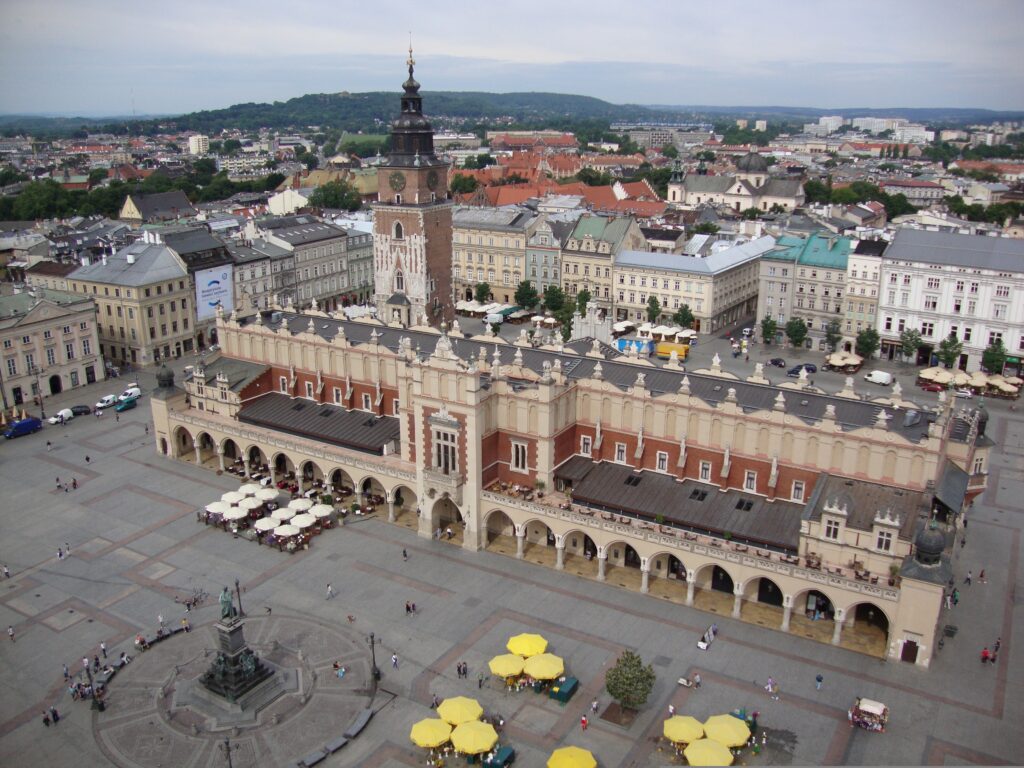
Kraków (KRAK-oof) is the city that most visitors to Poland fall in love with. Unlike Warsaw, it survived World War II largely intact, so what you see is the real deal: a medieval Old Town with a massive market square, a royal castle on a hill, and centuries of architectural layers from Gothic to Art Nouveau. It’s also Poland’s most touristy city, which means the main square can feel like Disneyland in August. But step a few blocks in any direction, and you’re in neighbourhoods where actual life happens.
The city is compact and walkable, the food is excellent, and it’s a natural base for day trips to Auschwitz-Birkenau and the Wieliczka Salt Mine. If you’re only visiting one city in Poland, Kraków is the safe bet. If you’re visiting two, pair it with Warsaw or Gdańsk.
Table of Contents
Where is Kraków?
Kraków sits in southern Poland, about 100 km north of the Slovak border and roughly 300 km south of Warsaw. It’s on the Vistula River at the edge of the Lesser Poland Uplands. The Tatra Mountains (Poland’s best hiking) are about 2 hours south by car or bus.
How to get to Kraków?
Kraków has its own international airport and is well connected by rail. Getting here from the US usually means either a direct flight to Kraków or flying into Warsaw and taking a short train ride south.
✈️ Flights to Kraków from the USA
LOT Polish Airlines operates a direct flight from Chicago O’Hare (ORD) to Kraków’s John Paul II Airport (KRK). As of 2026, this flies once per week (Sundays) on a Boeing 787 Dreamliner. Flight time is about 9 hours and 15 minutes. Round-trip fares typically start around $500–700 in economy.
Chicago is currently the only US city with a direct Kraków connection. If you’re flying from elsewhere in the US (New York, LA, Miami, etc.), your best options are: (1) Fly direct to Warsaw on LOT, then take a 2.5-hour train to Kraków. Trains run frequently and cost around 100–150 PLN (~$25–40). (2) Connect through a European hub. Lufthansa (Frankfurt/Munich), KLM (Amsterdam), and Turkish Airlines (Istanbul) all offer one-stop routings to Kraków at competitive prices, typically $400–700 round-trip.
Tip: sometimes it’s cheaper to book two separate tickets (US to a European hub on one ticket, then a budget carrier to Kraków on another) than a single through-fare. Ryanair and Wizz Air fly to Kraków from dozens of European cities for pocket change.
✈️ Flights to Kraków from the UK
Kraków is one of the easiest Polish cities to reach from the UK. There are direct flights from multiple British airports on budget and full-service carriers.
From London, your options include Ryanair (Stansted), easyJet (Gatwick, Luton), Wizz Air (Luton), and British Airways (Heathrow). Between these four, there are 60+ direct flights per week from London alone. Return fares with budget carriers start as low as £30–60 if you book early and travel light.
From other UK cities: easyJet flies from Edinburgh and Bristol. Ryanair operates from Edinburgh, Manchester, and Leeds/Bradford. Jet2 flies seasonal routes from several UK airports. Flight time from London is about 2 hours and 30 minutes.
All flights land at Kraków John Paul II Airport (KRK), which is 11 km west of the city centre. A train runs from the airport to Kraków Główny (main station) in about 20 minutes for 12 PLN (~$3 / €3 / £2.50). Taxis cost about 80–100 PLN (~$20 / €18 / £16).
🚆 Trains to Kraków
From Warsaw, PKP Intercity runs frequent trains (roughly every hour during peak times). The fastest takes about 2 hours 20 minutes on the EIP (Pendolino) service, with fares starting around 100 PLN (~$25) if booked in advance. Standard IC trains take about 2.5–3 hours.
New in 2026: Leo Express and RegioJet have launched services between Kraków and Warsaw, giving more options and sometimes cheaper fares. Leo Express also runs trains from Kraków to Prague (about 7 hours), which is handy if you’re combining Poland with the Czech Republic.
From Berlin, there are now direct EuroCity trains running through Wrocław to Kraków, part of the expanded Germany-Poland rail schedule. The journey takes about 7–8 hours. Alternatively, train to Warsaw and connect from there.
Kraków Główny (main station) is directly underneath the Galeria Krakowska shopping centre, right next to the Old Town. You walk out of the station, and you’re essentially there.
Where to sleep in Kraków?
The Old Town (Stare Miasto) is the most convenient base, but also the most expensive and noisiest at night, especially in summer. Kazimierz, the former Jewish quarter, has become the nightlife and cafe district, and it’s about a 15-minute walk from the main square. It’s where I’d stay.
Podgórze, across the river, is quieter and cheaper, with good restaurants and the Schindler Factory Museum on your doorstep.
Budget hostels run 50–100 PLN (~$13–25 / €12–23 / £10–20) per night for a dorm bed. Mid-range hotels in Kazimierz or the Old Town cost 250–500 PLN (~$65–130 / €60–120 / £50–100). Apartments are often the best value for couples or groups.
How to get around Kraków?
Kraków’s centre is small enough to walk everywhere. From the Wawel Castle to the northern edge of the Old Town is about 20 minutes on foot. Trams and buses cover the wider city if you need them, with a single ticket at 5 PLN (~$1.25). Buy from machines at stops or use the Jakdojade app.
Uber and Bolt are widely available and cheap. A ride from Kazimierz to the Old Town costs about 10–15 PLN. You really don’t need a car in Kraków, and parking in the centre is expensive and stressful.
What to do in Kraków?
The Rynek Główny (Main Market Square) is Europe’s largest medieval town square, and it’s the obvious starting point. The Cloth Hall (Sukiennice) runs down the middle, with souvenir stalls on the ground floor and a gallery of 19th-century Polish art upstairs. St. Mary’s Basilica (Kościół Mariacki) has that famous altarpiece by Veit Stoss that took twelve years to carve. Every hour, a trumpeter plays the hejnał from the tower, cutting off mid-note to commemorate a 13th-century watchman shot by Mongol invaders.
Wawel Castle sits on a limestone hill above the Vistula and was the seat of Polish kings for centuries. The State Rooms and Crown Treasury are worth seeing. Buy tickets early in the day because they’re timed and sell out, especially for the State Rooms. The castle grounds are free to enter.
Kazimierz was Kraków’s Jewish quarter for 500 years. Today, it’s the city’s cultural and nightlife hub, full of independent bars, bookshops, and galleries. The Old Synagogue and Remuh Synagogue are both worth visiting. For the full WWII story, cross the river to Podgórze and visit Schindler’s Factory (Fabryka Emalia Oskara Schindlera), which is now an excellent museum about Kraków under Nazi occupation. Book online in advance; walk-up tickets sell out.
Auschwitz-Birkenau is about 70 km west of Kraków. Most people visit as a day trip (bus or organised tour, about 1.5 hours each way). Entry to the memorial is free, but guided tours (strongly recommended for Auschwitz I) cost around 90–130 PLN (~$23–35). Book well ahead on the museum website (visit.auschwitz.org), especially in summer.
The Wieliczka Salt Mine (vee-LEECH-kah) is 15 km southeast of Kraków and makes for a great half-day trip. The underground chambers, chapels, and salt sculptures are genuinely impressive. Tickets are about 120 PLN (~$30 / €28 / £24).
Learn more about what to do in Kraków.
What to eat in Kraków?
The main square is lined with restaurants, and about half of them are tourist traps charging 70–90 PLN for average pierogi. Walk a few blocks in any direction and prices drop while quality goes up.
Kuchnia u Babci Maliny (just off the main square, basement level) serves traditional Polish food at fair prices in a setting designed to look like your grandmother’s kitchen. It’s touristy, but the food is legit. Try the żurek (sour rye soup served in a bread bowl).
In Kazimierz, Starka does modern Polish cuisine with a good vodka selection. Hamsa serves Middle Eastern food that’s become a local favourite. For cheap eats, look for a milk bar (bar mleczny) like Bar Mleczny Gornik near the main square, where a full lunch costs 15–25 PLN.
For street food, grab an obwarzanek from any street vendor. It’s Kraków’s signature snack: a twisted bread ring coated in poppy seeds, sesame, or salt. Costs about 2–3 PLN. You’ll see them sold from blue carts everywhere. And yes, Żabka is here too. Same deal as everywhere in Poland: the ubiquitous green convenience store for coffee, snacks, and late-night essentials.
FAQ
Three days gives you time for the Old Town, Kazimierz, Wawel Castle, and either Auschwitz or Wieliczka. Four or five days lets you do both day trips and still explore at a relaxed pace.
May to September for warm weather and outdoor cafe season. July and August are the busiest months. December is magical for Christmas markets but cold (around -5 to 2°C / 23 to 36°F). November and March are the quietest and cheapest months but grey.
Yes, and most people do. It’s about 1.5 hours by bus or car. Organised tours depart daily from Kraków and handle transport and guiding. You can also go independently by bus from the main bus station.