Most Warsaw guides send you to the same six places: Old Town, Palace of Culture, Łazienki Park, Royal Castle, Uprising Museum, POLIN. Those are all worth doing, and we cover them in our first-timer’s guide to Warsaw.
But if you’ve already done that list, or you’re in your twenties or thirties and want to know what locals actually do on a Saturday night, that itinerary won’t get you there.
The cool stuff in Warsaw isn’t really in the centre. It’s in the courtyards behind it, the converted factories of Praga, the queer techno clubs that don’t open until 2 AM, and the late-night dumpling spots that tourists never find because Google Maps doesn’t translate the menus.
I live in Poland, I know the city, and I’ll flag what’s worth your time if you’ve already done the basics or you don’t care about ticking off the basics in the first place. Prices are in PLN with USD, EUR, and GBP conversions.
Table of Contents
1. Drink in Pawilony, the courtyard of weird bars off Nowy Świat
Pawilony is a horseshoe-shaped courtyard tucked behind Nowy Świat 22/28. You’d walk past the entrance ten times without noticing it.
Inside, around twenty small bars cram into former kiosks built in the 1960s, each one independently run with its own personality. One does only natural wine. One is a dive bar with metal music and 8 PLN beers. One has a Cuban theme. One looks like a post-apocalyptic library.
Full of students from closeby Warsaw University campus, this place is alive everynight. It gets going around 10 PM and stays loud until 3 or 4 AM on weekends.
Beers run 12–18 PLN (~$3–4.50 / €3–4 / £2.50–3.50), shots from 8 PLN. There’s no door policy at most places, no dress code, and nobody’s filming for TikTok.
Local tip: skip the bars at the entrance, they’re the most touristy. Walk all the way to the back of the courtyard. The good ones are at the far end.
2. Go to a club night at Smolna or Jasna 1
Warsaw’s club scene is built around two main rooms in the centre, Smolna and Jasna 1, plus a constellation of warehouse parties that move around. Smolna is the big one: three floors, mostly techno and house, runs until 8 AM on weekends.
Cover is around 40 PLN (~$10 / €9 / £8) and it does fill up, so come early or queue. Jasna 1 is smaller, more curated, and books better international DJs on average.
For something more underground, follow the parties run by Brutaż, Wixapol, or Slot Art. These don’t have permanent venues. They pop up in former factories, abandoned buildings, or warehouses across Praga and Wola, and tickets are usually 50–80 PLN (~$13–20 / €12–18 / £10–16).
Tip: Resident Advisor and Facebook events are the best way to find them.
3. See a queer drag show at Galeria
Warsaw has the most active LGBTQ+ scene in Central Europe, which can be quite surprising for people who know a bit about Polish politics. Despite constant fight over LGBTQ+ people’s rights, Warsaw is safe, open and welcoming.
And so is Galeria on Marszałkowska Street, taht runs drag nights, queer dance parties, and karaoke that draws a mixed crowd.
Klubokawiarnia is another classic: bar by day, club by night, openly queer-friendly with a basement dance floor. For something more polished, Bar Studio inside the Palace of Culture is technically a theatre bar but draws a heavily creative-class queer crowd at weekends.
4. Tour the Warsaw street art in Praga
Praga has the best street art in Poland. Most of it is concentrated in a 15-minute walking radius around ul. Ząbkowska, Targowa, and the Soho Factory area.
The murals range from massive Brazilian-influenced pieces commissioned for festivals to scrappy local stencils, and you’ll find new ones every few months.
A few specific ones to look for: the Madonna of Praga (a 1950s Marian shrine in a courtyard at Mała 7, where locals leave fresh flowers daily), the giant kangaroo mural on Stalowa Street (no, nobody knows why), and the Bruno Schulz mural near Wileński station.
Free Walking Tour Warsaw runs a Praga-specific tour for tips-only (suggested 30–50 PLN / ~$8–13), and they actually know the artists.
For DIY: just wander north from Wileński station up Targowa, then loop back via Ząbkowska. Two or three hours, free, and you’ll see a side of the city most tourists never bother with.
5. Eat at a vegan milk bar / bar mleczny
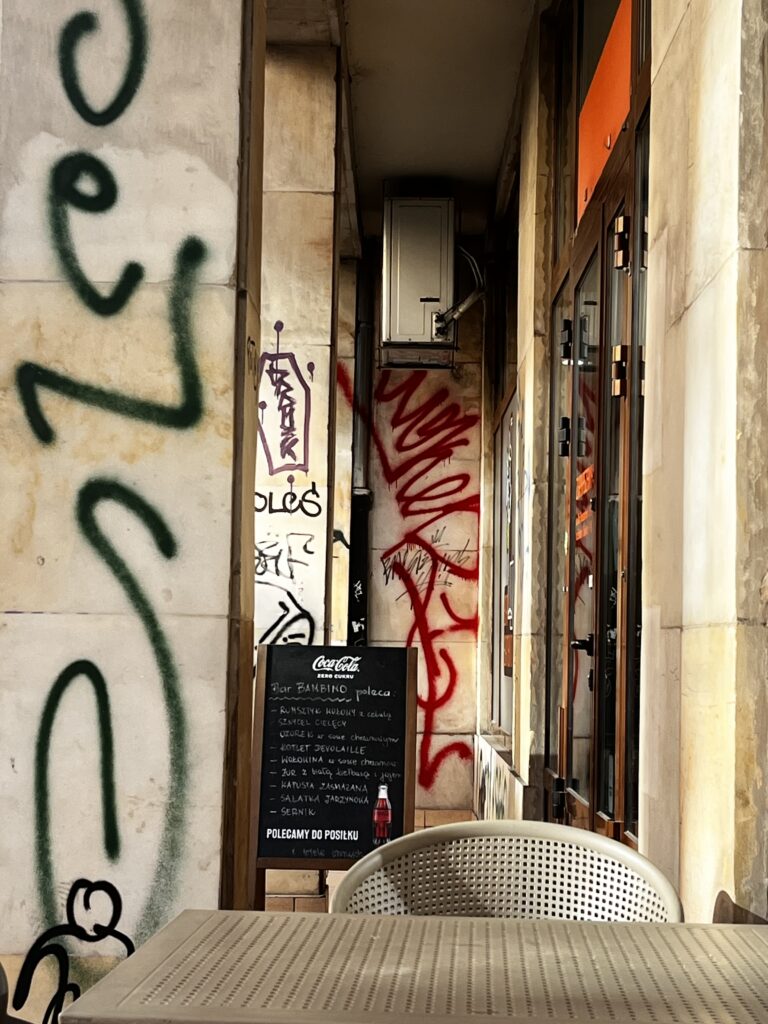
If you’ve already done the traditional milk bar circuit (Bar Prasowy, Bar Bambino), Warsaw has a vegan food scene that gets less coverage internationally.
Lokal Vegan Bistro in Praga does updated Polish classics fully vegan: pierogi with seitan and cabbage, żurek with smoked tofu instead of sausage, and a vegan szarlotka (apple cake) that’s better than most non-vegan ones. Mains around 35–45 PLN (~$9–11 / €8–10 / £7–9).
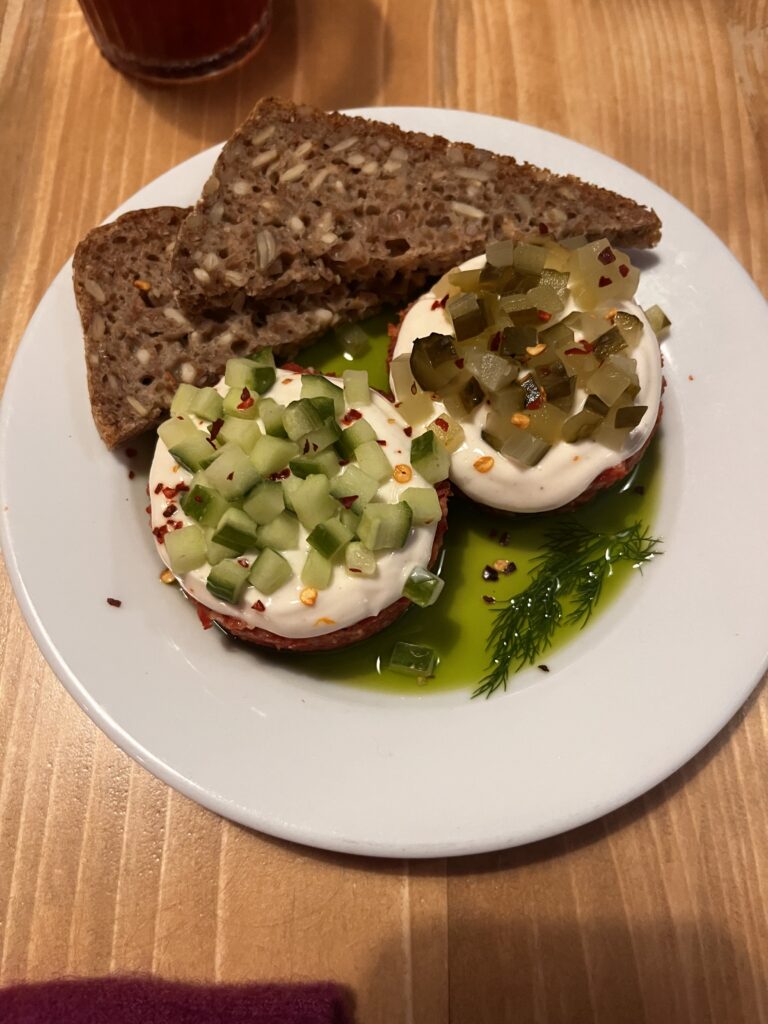
Warsaw has been ranked among the top vegan-friendly cities in Europe a few times, and it’s not a coincidence. The city has a young, design-forward food scene that took to plant-based cooking early.
6. Take a Fiat 126p tour around the city
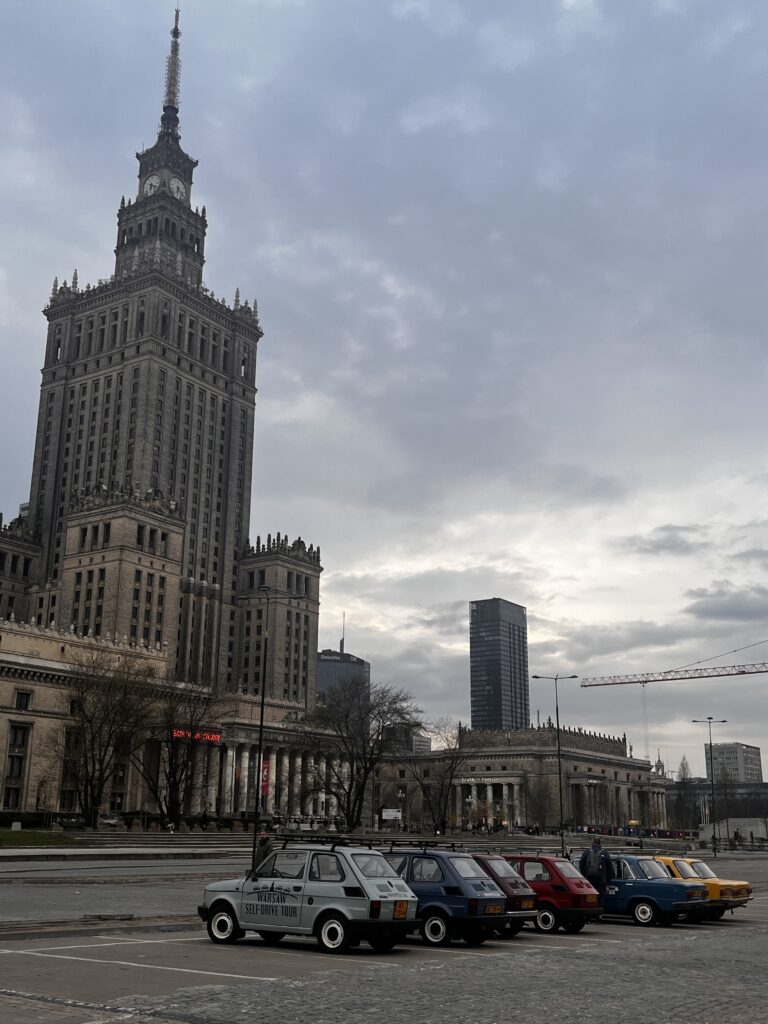
This is one of the most fun things you can do in Warsaw on a sunny afternoon, also for the locals! You can rent a Fiat 126p (the „Maluch”, which means „little one” in Polish) right by the Palace of Culture and drive around the city in a car that defined Polish life for forty years.
The Maluch was the people’s car of communist Poland, produced from 1973 to 2000, with a 600cc engine that struggles up hills and a top speed that’s optimistic at best. Most Polish families had one. Most Polish drivers learned in one. The car is barely 3 metres long and looks like a big cartoon.
Several operators run Maluch tours from the parking lot near the Palace of Culture (the main pickup spot is on the western side near Plac Defilad).
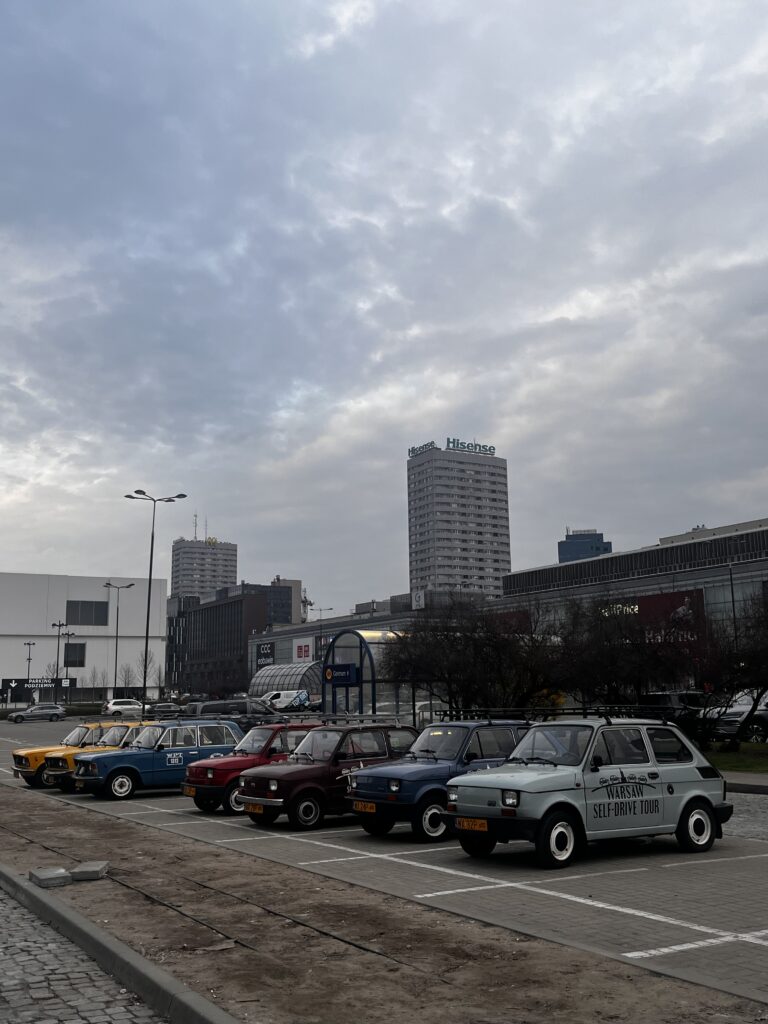
Self-drive rentals run around 200–300 PLN (~$50–75 / €46–70 / £40–60) for a few hours, and guided tours with a driver who tells you stories about communist-era Warsaw run 250–400 PLN (~$63–100 / €58–93 / £50–80) per car. The cars seat four if you’re friendly.
Local tip: if you want something a bit different, some operators rent vintage Polish Trabants and Polonezes too. The Trabant is German technically, but it’s the same era and same vibe, and the smell of two-stroke fuel is part of the experience.
7. Take a Vistula river cruise, but the cheap commuter ferry version
Most „Vistula river cruises” sold to tourists are 60 PLN, an hour long, and underwhelming.
The locals’ version: in summer (May–September), the city runs free passenger ferries across the Vistula at multiple points along the boulevards. They take 5 minutes, they’re free with any 24-hour transit ticket (15 PLN / ~$4 / €3.50 / £3), and they give you exactly the same view as the paid cruises for a fraction of the time and money.
Hop on at Podzamcze, ride to the Praga side, walk along the wild beach there (yes, Warsaw has a city beach with actual sand), and ferry back.
In summer, the Praga riverbank has outdoor bars, fire pits in the evening, and a much more local crowd than the western boulevards.
The ferries run roughly hourly from late morning to evening. Check the city transit website (ZTM Warszawa) for the current schedule, the route map is in English.
8. Go to a record store in a former bunker, Side One
Side One on Hoża street is a vinyl record store in a converted air raid shelter, with the original concrete walls and steel doors still in place.
It stocks Polish jazz, post-punk, electronic music, and a strong selection of Eastern European rarities you won’t find easily abroad. Vinyl runs from 60 PLN for new releases up to 300+ PLN for collector items.
If you’re a music person, also worth visiting: Hot Spot Records in Praga (deep funk and hip-hop), and Pardon, To Tu, a jazz venue and bar on Plac Grzybowski that does live gigs most nights and is one of the best small jazz rooms in Central Europe. Cover is usually 30–60 PLN (~$8–15 / €7–14 / £6–12).
9. Eat Vietnamese pho in Warsaw’s Little Vietnam
Warsaw has the largest Vietnamese community in Poland, around 25,000 people, mostly second-generation, concentrated in the Wola district.
The food scene that’s grown out of it is excellent and almost entirely unknown to international visitors who come expecting „Polish food only.”
Pho Vegan on ul. Wilcza does the best pho in the city for around 35 PLN (~$9 / €8 / £7) a bowl. Bun Cha Cha in the Wola district is a small family-run place where bun cha is 38 PLN, the chili is real, and the queue at lunch is the best endorsement. Mì Việt Nam at the Hala Mirowska market does cheap, fast, authentic banh mi for 18 PLN.
Eating Vietnamese in Warsaw isn’t a „fusion” thing or a novelty. It’s everyday food for a lot of Varsovians. Worth a meal.
10. Hunt for the bullet holes (and other things in plain sight)
This isn’t a single attraction, it’s a way of walking the city. Warsaw is full of WWII bullet holes that have been deliberately left in walls.
You’ll find them on the Prudential Building (now Hotel Warszawa) facing Plac Powstańców, on the surviving fragments of the Ghetto wall on ul. Sienna and ul. Złota, and on the Royal Castle’s outer walls.
Once you start looking, you can’t stop.
Other things hiding in plain sight: the brass plaques (called „kamienie pamięci”) embedded in pavements across the former Ghetto area, marking the addresses where deported Jewish residents lived; the Polish underground postbox on ul. Świętokrzyska (a normal-looking metal box from which the resistance ran an underground postal system during the war); and the surviving fragment of the original Ghetto wall in a courtyard at ul. Sienna 55, accessible through a regular apartment building during daytime hours.
This kind of slow-walking the city is one of the more meaningful things to do in Warsaw, and it costs nothing. The Warsaw Footsteps app (free, in English) maps these locations.
11. Take the slow train to Konstancin for a thermal spa day
Most Warsaw guides will send you to Wilanów or Łazienki for a green-space day. Here’s a better one for repeat visitors: Konstancin-Jeziorna, a spa town 20 km south of Warsaw that’s been a wellness destination since the 19th century.
Wealthy Varsovians came here to drink the salt water, take mud baths, and walk the parks. It’s still doing the same thing.
The main draw is the Tężnia, a graduation tower (a wooden structure with brushwood walls dripping with brine) that creates a natural saline microclimate you walk through. Locals come for the respiratory benefits; you can come because it’s odd and feels like nothing else in Poland. Free to walk around.
Take the local train (S2) from Warsaw Central to Konstancin-Jeziorna for about 10 PLN (~$2.50 / €2.30 / £2). 30 minutes each way. The town is small, easy to walk, and has a few good restaurants if you want to make a day of it.
12. See Polish cinema at the Palace
Most visitors to the Palace of Culture take the lift to the 30th-floor observation deck and leave. Locals know the building has an independent cinema inside it, and it’s one of the more atmospheric places in Warsaw to watch a film.
Kinoteka opened in the late 1950s as part of the Palace’s original cultural programme and has been showing films continuously since then. The interior keeps original 1950s socialist-realist details: marble columns, heavy red curtains, chandeliers, and brass railings. Buy at the box office or at kinoteka.pl.
If Kinoteka’s programme doesn’t match your dates, two other cinemas worth knowing: Kino Iluzjon on ul. Narbutta is the National Film Archive’s cinema, showing classic Polish films and restored prints (22 PLN).
Kino Muranów on Plac Zamenhofa is the city’s best independent cinema for current releases, with a good espresso bar and a crowd heavy on film school students.
In summer, both run open-air film festivals in courtyards and on rooftops. Watch for the Warsaw Film Festival (October) and Millennium Docs Against Gravity (May) if your dates align.
If you’re after the cool side of the city, don’t miss a night out at Pawilony, an evening on the Praga riverbank in summer, and at least one proper club night at Smolna or one of the warehouse parties. A Maluch tour around the centre is also one of the most fun afternoons you can have here. For the unmissable mainstream stuff (Old Town, Uprising Museum, POLIN), see our full first-timer’s guide.
WWII history and the destruction-and-reconstruction story, Chopin, the Palace of Culture and Science, vodka, and increasingly its underground music and creative scene. The city has been quietly building a reputation as one of Central Europe’s more interesting nightlife capitals over the last decade.
Not at all. If anything, three days is when Warsaw starts to make sense. Day one for the historical core (Old Town, Royal Route, Uprising Museum); day two for Praga, the river, and a proper night out; day three for the unusual stuff: Pawilony, vegan food, niche museums, a Maluch ride, or a thermal spa day in Konstancin. Two days is rushed, four lets you slow down.
For me, Warsaw was love at first sight, but I may not be fully objective. If you’re someone who likes Berlin more than Vienna, Glasgow more than Edinburgh, you’ll like Warsaw more than Kraków.
Yes. It’s arguably one of the best cities in Central Europe for travellers in their twenties and thirties right now. Cheap drinks (by Western European standards), an active electronic music and queer scene, and a city that’s small enough to walk and big enough to have layers. Also super safe! Pair it with Berlin or Prague and you’ll see how it makes Prague feel touristy and Berlin feel expensive.