
Poland tends to get lumped in with „Eastern Europe” in a way that makes it sound vaguely risky. It isn’t. If you’re asking whether Poland is safe for a trip in 2026, the short answer is yes — and not in a hedged, „it’s fine if you’re careful” way. It’s genuinely one of the safer countries in Europe to visit.
Poland is safe by every meaningful measure. The homicide rate sits below 1 per 100,000 people, lower than France, Germany, or Italy. The U.S. State Department rates it Level 1, their lowest risk category, and the UK’s FCDO has no advisory against travel. Violent crime targeting tourists is rare. The proximity to Ukraine understandably worries people, but Poland is a NATO member with one of the largest defence budgets on the continent, and the border region is calm for visitors.
The risks that do exist are real but manageable:
| Risk | Where | What to do |
|---|---|---|
| Pickpocketing | Kraków’s Main Square, Warsaw Old Town, crowded trams | Front pockets, bag zipped and in front of you on the 15 and 24 trams |
| Nightlife scams | Kraków and Warsaw strip-club touts, a few Old Town bars with no visible prices | Ignore anyone handing out club flyers; check the menu price before ordering |
| Taxi overcharging | Airport ranks, taxis idling outside tourist sites | Use Bolt, Uber or FreeNow instead of hailing |
| Hostility toward LGBTQ+ travellers | Rural areas and small towns; much less so in big cities | Cities are fine; be more aware in the countryside |
This article covers all of it: the crime statistics, what the war in Ukraine actually means for traveler, area-specific advice for Warsaw and Kraków, and the scams worth knowing about. By the end, you’ll have a clear picture of what to expect.
Table of Contents
Is Poland safe for tourists in 2026? Quick answer
Poland is one of the safer countries you can visit in Europe right now. The U.S. State Department rates it Level 1: Exercise Normal Precautions — the lowest possible risk level, the same rating given to countries like Japan and Portugal. The Global Peace Index consistently places Poland in the upper tier of peaceful nations worldwide, and the country’s homicide rate sits well under 1 per 100,000 people, which is lower than the United States, the UK, and most of Western Europe.
That’s how it looks at the moment, but you can always check this here
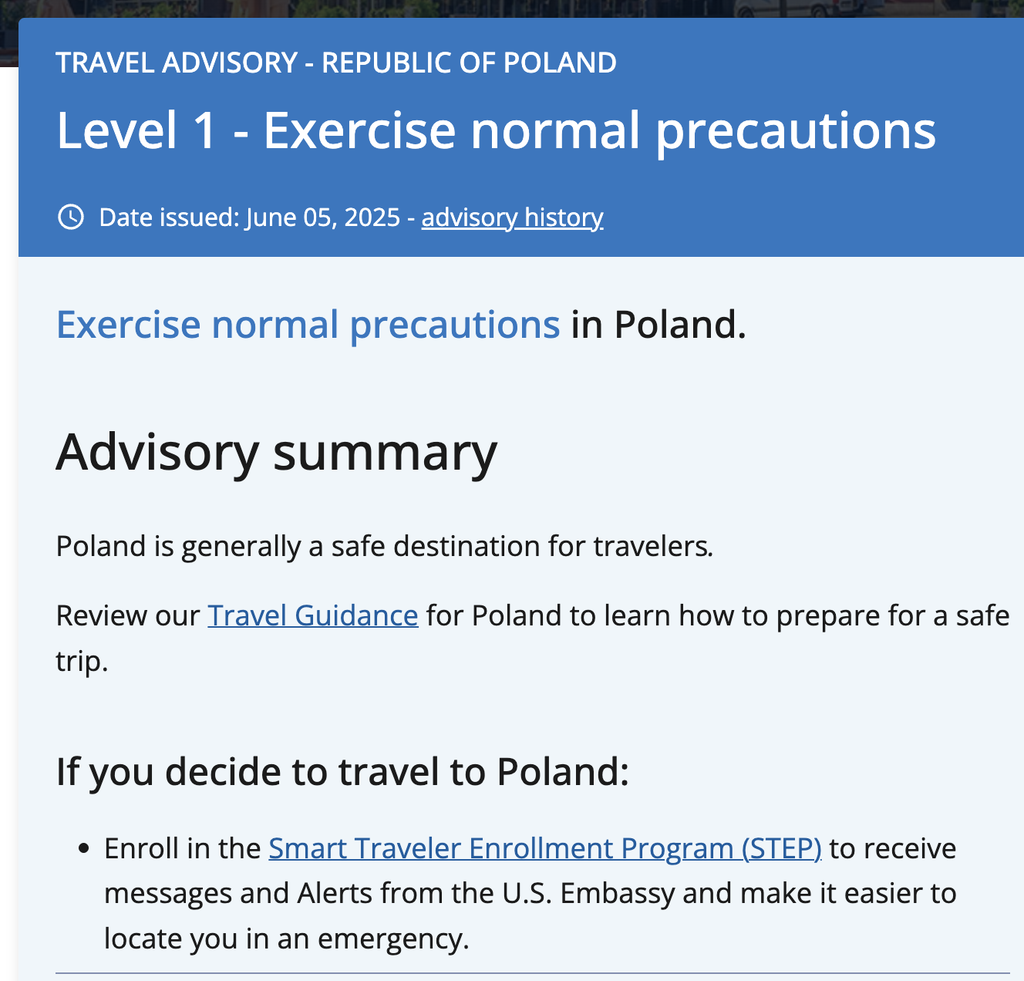
Every major English-speaking government agrees on this assessment:
- United States (State Department): Level 1 — Exercise Normal Precautions
- United Kingdom (FCDO): No advisory against travel to Poland
- Canada (travel.gc.ca): Exercise normal security precautions
- Australia (Smartraveller): Exercise normal safety precautions
That’s about as clean a sweep as a destination gets.
So is Poland safe to visit in 2026, or no?
Short answer: yes, Poland is safe to visit in 2026. Day-to-day risk for tourists is low, and violent crime against visitors is rare. Three concerns come up often enough to address properly:
| Concern | The reality |
|---|---|
| Petty theft | Real in busy city centres — crowded trams, main squares, train stations. Normal European precautions cover it. |
| LGBTQ+ travel | The political climate is complicated. Big cities are relaxed; small towns and rural areas can be noticeably less so. |
| The war in Ukraine | Poland borders it, but the border region is calm for visitors and daily life is unaffected. |
None of these makes Poland a dangerous destination. They mean you go in informed, which is true of anywhere in Europe.
The sections below get into each of those concerns properly, so you can make your own call.
Poland crime rate compared to other European countries
Poland is one of Europe’s safer destinations, and the numbers back that up. Poland’s homicide rate sits below 1 per 100,000 people — lower than the EU average, and lower than France, Germany, and Italy. On the 2024 Global Peace Index, Poland ranked in the top third of countries worldwide, which puts it ahead of several Western European nations that tourists visit without a second thought.
To put that in perspective, here’s how Poland compares to countries you might already be considering for your trip:
| Country | Homicide rate (per 100,000) |
|---|---|
| Poland | ~0.7 |
| Italy | ~0.5 |
| Germany | ~1.0 |
| EU average | ~1.1 |
| France | ~1.3 |
Source: Eurostat / UNODC. Figures are approximate and reflect recent available data.
Violent crime against tourists is rare. The safety risks that do exist in Poland are the same ones you’d encounter in any major European city: pickpocketing in crowded areas, bag snatching on busy trams, and the occasional scam targeting distracted tourists. Warsaw’s central train station and Kraków’s Old Town are the spots where petty theft is most likely — not because they’re dangerous, but because that’s where large crowds and opportunity meet. Keep your phone in your front pocket and your bag in front of you on public transport, and you’re dealing with the same precautions you’d take in London or Rome.
Poland crime rate compared to other European countries is a search a lot of people run before booking, usually because they’re not sure what to expect. The short answer: Poland is a low-crime country by European standards, and the risks that exist are manageable with basic awareness.
Why is Poland’s crime rate so low?
A few factors contribute to Poland’s low crime figures. Gun ownership is tightly restricted — Poland has some of the strictest firearms regulations in Europe, which keeps gun-related violence extremely low. Community ties remain strong, particularly outside major cities, and social trust tends to be high. Poland also has a relatively low rate of drug-related crime compared to Western European counterparts, which drives down a significant category of urban violence elsewhere on the continent.
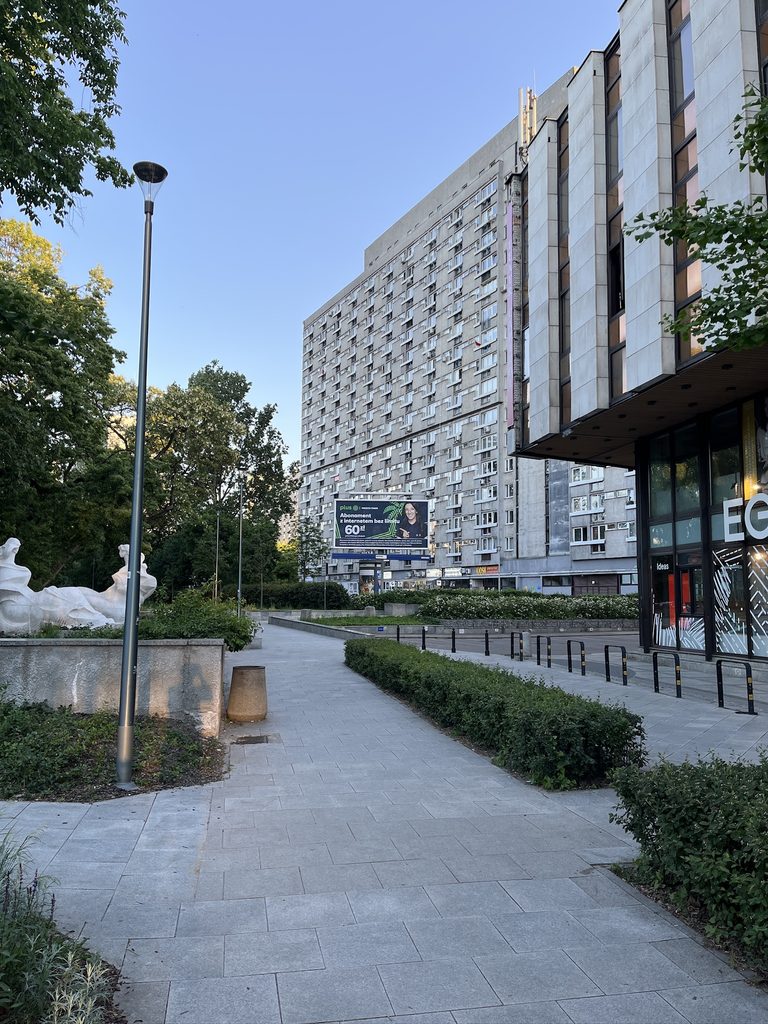
Regular street in Warsaw, as you can see there’s nothing to be afraid of. Maybe only late-capitalism with their ads all over the city.
Policing is visible and generally effective. You’ll see officers regularly in city centres, at transport hubs, and during public events. It’s worth noting that Poland’s demographics have historically been less diverse than Western Europe, which some researchers cite as a factor in social cohesion — though that’s changing as the country becomes a destination for economic migration from Ukraine and beyond. None of this means Poland is problem-free, but it does explain why the crime statistics look the way they do: a combination of policy, culture, and social structure that keeps violent crime low.
Is Poland safe because of the war in Ukraine?
This is the question I get more than any other, and I understand why. Watching the news, it can feel like the whole region is on edge. But there’s a significant gap between what the headlines suggest and what life actually looks like on the ground in Poland — and that gap matters a lot if you’re deciding whether to book a trip.
Poland shares a border with Ukraine to the southeast and with Belarus to the northeast. That’s a geographic fact, and it’s reasonable to take it seriously. What it doesn’t mean is that Warsaw, Kraków, or Gdańsk are anywhere near a conflict zone. Poland has been a NATO member since 1999, which means it operates under Article 5 — the collective defence clause that commits all 32 member states to treat an attack on one as an attack on all. Russia is well aware of this. The practical effect is that Poland is one of the most militarily protected countries in Europe right now, with NATO troops, air defence systems, and allied air patrols operating across Polish territory.
Has the war changed things in Poland? Yes, in specific ways. The country absorbed over a million Ukrainian refugees, which reshaped certain cities and put pressure on housing and services. There have been isolated incidents — stray drones crossing into Polish airspace near the eastern border, air defence alerts in the Lublin and Rzeszów regions — that generated alarming headlines. Polish authorities take these incidents seriously, and the security posture in eastern Poland is genuinely heightened. But none of these incidents affected tourist destinations, and none represented a direct military threat to civilians.
If you’re visiting Poland to see Kraków’s Old Town, walk the Gdańsk waterfront, or spend a weekend in Warsaw, the war in Ukraine is background context, not a present danger.
Is Poland safe from war? Understanding the risk
The honest answer is that the risk depends almost entirely on where in Poland you’re going. Kraków sits roughly 300 kilometres from the Ukrainian border. Warsaw is further still. For the vast majority of tourists, the conflict zone is as geographically remote as it would be from Vienna or Budapest.
The areas that warrant more caution are in the far east — the border regions near Ukraine and, especially, near Belarus. Poland maintains a restricted zone along the Belarusian border due to ongoing hybrid pressure campaigns and irregular migration incidents. Tourists have no business reason to be in this zone, and Polish authorities actively discourage it. If your itinerary doesn’t include eastern Podlaskie or the Białowieża border crossings, this doesn’t affect you.
Entry into Poland is straightforward. Poland is a Schengen member, so US and UK citizens travel visa-free for up to 90 days in any 180-day period. No visa, no pre-approval, no paperwork beyond your passport.
Two EU border systems are worth knowing about:
| System | Status | What it means for you |
|---|---|---|
| EES (Entry/Exit System) | Live since April 2026 | Biometric border checks — your photo and fingerprints are taken on your first entry, replacing the passport stamp. Done at the border, nothing to do in advance. Expect slower queues at peak times. |
| ETIAS (travel authorisation) | Not in operation; no launch date announced | When it does launch, it’ll be a quick online registration — not a visa. The EU has said it will announce the start date several months beforehand, so there’s nothing to apply for yet. |
Check the official ETIAS page before you travel — the timeline has slipped several times and the EU site is the only source worth trusting on it.
Terrorism in Poland: what travelers need to know
Poland has never experienced a major terrorist attack, and that track record matters. The country doesn’t have the same history of domestic or international terrorism incidents that some Western European nations have faced over the past decade. That said, the threat level isn’t zero, and Polish authorities are the first to say so.
Poland’s official terrorism threat level sits at the second-lowest tier on the national scale — „low” rather than „no risk.” The main reason the assessment isn’t cleaner than that is geopolitical:
Poland has become one of NATO’s most important logistics corridors since Russia invaded Ukraine in 2022. Military equipment moves through Polish territory, NATO personnel are stationed here, and Warsaw has positioned itself as one of Ukraine’s strongest political allies. That visibility comes with some degree of exposure.
For a tourist walking around Kraków’s Old Town or catching a train from Warsaw Centralna, this is largely background noise. Polish internal security services (ABW) are well-funded and active. There’s a visible security presence at major transport hubs, public events, and government buildings — not in an alarming way, just in a way that suggests the authorities are paying attention.
The practical advice here is the same as it would be in London, Paris, or Berlin: stay aware of your surroundings in crowded public spaces, know where the exits are, and report anything that looks genuinely out of place. That’s not paranoia — it’s just sensible travel behaviour anywhere in Europe.
Is it safe to travel to Poland because of Iran?
In recent years, Polish and international media have reported on alleged Iranian-linked plots targeting infrastructure and individuals connected to NATO operations in Poland. Polish authorities have made arrests in connection with these investigations, which suggests the threat is being taken seriously — and actively managed.
For tourists, this specific threat is not directed at you. The targets in reported plots have been military logistics infrastructure and high-profile political figures, not visitor attractions or civilian areas. It’s worth knowing the context exists, but it shouldn’t factor into your decision to travel to Poland. The ABW’s response to these cases has been swift, and Poland’s security cooperation with NATO allies gives it significant intelligence resources to work with.
Is Poland safe for different types of travelers?
Safety in Poland isn’t a single answer — it depends a lot on who you are. A solo woman navigating Kraków’s nightlife has different things to think about than a same-sex couple visiting a small town in rural Masovia, or a Muslim traveler trying to find a halal meal in Gdańsk. Poland is, by most measures, a safe country to visit. But „safe” isn’t the same as „uncomplicated,” and some travelers will encounter friction that others won’t. The sections below break it down honestly, by traveler type.
—
Is Poland safe for solo female travelers?
Poland is safe for solo female travelers in the sense that violent crime against tourists — male or female — is genuinely rare. Street harassment exists, particularly around nightlife areas in Warsaw and Kraków, but it’s generally low-level: unwanted attention, the occasional comment. It’s unpleasant, not dangerous, and it’s not substantially worse than what you’d encounter in Paris or Prague.
The bigger risks at night are the same ones that apply in most European cities: drink spiking does happen in bars, so keep an eye on your glass and don’t accept drinks from strangers you haven’t watched pour. For transport after dark, use Bolt or Uber rather than hailing a street taxi — it’s not that street taxis are especially dangerous, but the app gives you a record of the journey and a fixed price, which removes two variables at once.
Public transport in Warsaw and Kraków is generally fine to use at night, including the metro. Well-lit, reasonably busy, no particular red flags. If you’re heading home late from a club, the app-based options are just more convenient anyway. Trust your instincts in bars — Polish nightlife is lively and mostly good-natured, but crowded venues with a lot of alcohol follow the same rules everywhere.
—
Is Poland safe for Black tourists?
Poland is a predominantly white country, and outside Warsaw, Kraków, and Wrocław, you may simply not see much diversity. That matters because the experience of being visibly different varies significantly by location. In the major cities, most Black travelers report no serious issues — stares occasionally, but nothing beyond the low-level awkwardness of being a visible minority in a homogeneous space.
Outside the cities, the picture is less consistent. Some Black travelers have reported unwanted comments or a more overt sense of being out of place in smaller towns and rural areas. Violent, racially motivated attacks on tourists are rare and not a pattern you’ll find in crime statistics, but the social discomfort can be real. It’s worth being honest about that rather than waving it away.
Practically: Warsaw and Kraków are your most comfortable bases. If you’re traveling to smaller towns — and there are good reasons to — traveling with a companion can reduce the low-level friction. Poland’s laws don’t discriminate, and the tourist economy genuinely welcomes visitors. The gap is between the legal reality and the social one, and it narrows considerably in urban areas.
—
Is Poland safe for Muslim travelers?
Poland is a conservative, majority-Catholic country, and that shapes the experience for Muslim travelers in a few practical ways. Halal food is available in Warsaw and Kraków — both cities have halal restaurants and some supermarkets stock halal options — but outside those cities, finding it takes more planning. Mosques exist in Warsaw and a handful of other cities; in smaller towns, you’re on your own for prayer space.
Visibly Muslim travelers, including women wearing headscarves, may encounter stares or the occasional rude comment, particularly outside major cities. Overt hostility toward Muslim tourists is uncommon, and there’s no legal risk. The social climate is more „unfamiliar” than hostile — Poland has a very small Muslim population, so many Poles simply have limited experience with Islam. Major cities are noticeably more comfortable than rural areas, and in tourist-heavy areas like Kraków’s Old Town, nobody is paying you special attention.
—
Is Poland safe for LGBTQ+ travelers?
Warsaw and Kraków have active LGBTQ+ scenes — Warsaw Pride is one of the larger events in Central Europe, well-attended and generally well-policed. In both cities, same-sex couples can move around without serious concern, and gay bars and clubs operate openly. The practical day-to-day experience in these cities is broadly tolerant, even if Poland hasn’t legalized same-sex partnerships at the national level.
Outside the cities, the picture changes. Rural areas and smaller towns are more socially conservative, and public displays of affection between same-sex couples may draw negative attention. Some municipalities previously declared themselves „LGBT-free zones” — most of these designations have since been reversed, partly due to EU funding pressure, but they reflected a real strain of social conservatism that hasn’t disappeared overnight.
Violent incidents targeting LGBTQ+ tourists are rare, but not entirely absent from the record. The practical advice: read your environment, be more circumspect in smaller towns than you would be in Warsaw, and check current travel advisories from organizations like ILGA-Europe for the most up-to-date picture. Pride events in the major cities are a different world from a Sunday market in a small rural town.
—
Is Poland friendly to foreigners?
Yes — but „friendly” here doesn’t look like it does in Ireland or Italy. Poles can seem reserved on first approach, especially older people who didn’t grow up around much international tourism. Don’t read that as hostility. Ask for help with something specific and most people will go well out of their way, Google Translate open on their phone if that’s what it takes.
Where English will get you through
| Where | How far English gets you |
|---|---|
| Warsaw, Kraków, Gdańsk, Wrocław | Fine almost everywhere — restaurants, hotels, museums, ticket desks. You’ll rarely struggle. |
| Anyone under 40, anywhere | Usually confident English, often very good. |
| Smaller towns and villages | Drops off sharply. A translation app earns its keep. |
| Older generations | Limited. German or Russian is more likely than English. |
The practical upshot: language is far less of a barrier than most first-time visitors expect, and the gap is generational rather than geographic. A 25-year-old in a village café may well speak better English than a 60-year-old in central Warsaw.
Unsafe areas in Warsaw and Krakow to avoid at night
Both Warsaw and Krakow are, by most European standards, pretty safe cities after dark. The tourist areas are well-lit, reasonably busy, and actively policed. That said, every city has its pockets — and knowing which ones to be aware of means you can make sensible decisions rather than just hoping for the best.
Unsafe areas in Warsaw to avoid at night
Warsaw’s city centre — Śródmieście, the Old Town, and the main tourist corridors — is fine at night.
The areas that warrant more caution are a bit further out. Praga, on the east bank of the Vistula, has a reputation that’s slowly being reworked as artists and cafés move in, but parts of it are still poorly lit and quiet after midnight, so it’s worth staying aware of your surroundings there.
The streets immediately around Warszawa Centralna station can attract petty crime late at night — nothing unusual for a major European train hub, but keep your bag close and don’t linger if you’re waiting alone.
Underpasses in outer districts are best avoided after dark; they’re often unlit and isolated, and there’s usually a street-level route that’s just as fast. For getting around at night, Bolt and Uber both work well in Warsaw and are cheap enough that there’s no reason to walk a dodgy route when a ride costs a few złoty.
Unsafe areas in Krakow to avoid at night
Krakow is genuinely one of the safer cities in Central Europe, and the Old Town around Rynek Główny (the main market square) stays busy and well-policed well into the night. The area around Krakow Główny station deserves the same awareness you’d give any major train station in Europe — it’s not dangerous, but it’s a spot where pickpockets operate and where you’ll occasionally encounter people looking to take advantage of disoriented arrivals. Kazimierz, the former Jewish quarter, is worth knowing about: the bar strip there draws large stag party crowds on weekends, and while it rarely turns threatening, it can get loud and chaotic late on a Friday or Saturday. Stick to the main lit streets and you’ll be fine. Isolated side streets off the tourist circuit — especially heading south toward the outer residential areas — are quieter and less patrolled, so it’s worth routing through busier roads if you’re walking back late. As in Warsaw, Bolt and Uber are your friends here.
Common scams and safety risks in Poland
Poland doesn’t have a serious scam problem, but it does have the same low-level tourist traps you’ll find in any popular European city. Know what to watch for and you’ll almost certainly have no issues.
Pickpocketing is the most common risk, and it’s concentrated in predictable places: the Kraków main market square (Rynek Główny) during summer, the Warsaw Metro — especially the central stations — and crowded trams in both cities. The usual rules apply: keep your bag in front of you, don’t leave your phone on a café table, and use an inside pocket or money belt if you’re carrying a lot of cash.
Taxi scams catch people at airports and main train stations. Unlicensed drivers — sometimes called „mafia taxis” locally — approach arrivals and quote fares that can be three or four times the going rate. Fix this easily: use Bolt or Uber, or take a cab from an official rank with a meter and a company name on the door. At Warsaw Chopin Airport, follow the signs for the official taxi queue rather than anyone who approaches you in the arrivals hall.
Nightlife scams cluster around strip clubs and certain tourist-facing bars near the Old Towns in Warsaw and Kraków. The setup is always the same: a friendly local (sometimes a woman, sometimes a tout on the street) invites you in, and you end up with a bill that bears no resemblance to the menu prices. If you didn’t pick the bar yourself, be cautious. Check reviews before you go out, and always ask to see a menu with prices before you order.
Drink spiking does happen in nightlife areas, more so in Kraków than elsewhere. Don’t leave your drink unattended, and don’t accept drinks from strangers in bars you don’t know well.
ATM fraud is rare but not unheard of. Use ATMs attached to banks rather than standalone machines in tourist areas, and always cover the keypad when entering your PIN. Avoid anyone who offers to „help” you at a cash machine.
Poland travel advisories: what official sources say
Every major English-speaking government currently rates Poland as one of the safer countries in Europe to visit. Here’s what each advisory actually says, so you can check for yourself before you book.
🇺🇸 United States — Level 1: Exercise Normal Precautions The U.S. State Department gives Poland its lowest-risk rating. The advisory notes the ongoing conflict in neighboring Ukraine and advises travelers to monitor the situation, but there are no restrictions on travel within Poland itself. Read the full U.S. advisory →
🇬🇧 United Kingdom — Advised with standard precautions The UK’s Foreign, Commonwealth & Development Office (FCDO) does not advise against travel to any part of Poland. It flags the Ukraine border region and notes that large public demonstrations can occur in cities. Read the full FCDO advisory →
🇨🇦 Canada — Exercise normal security precautions Canada’s travel.gc.ca portal assigns Poland its baseline safety level, with no elevated warnings. It echoes advice around the eastern border and general urban awareness. Read the full Canadian advisory →
🇦🇺 Australia — Exercise normal safety precautions Smartraveller rates Poland at its standard level. It highlights the proximity to the Ukraine conflict and advises Australians to stay informed. Read the full Australian advisory →
All four advisories essentially say the same thing: travel normally, stay aware of your surroundings, and keep an eye on news about Ukraine. None of them suggest Poland is a place to avoid.
Practical safety tips for visiting Poland
Most of what keeps you safe in Poland is common sense you’d apply anywhere in Europe. A few things are specific to this country, though, and worth knowing before you go.
Know the emergency numbers. 112 is the universal emergency number and works from any phone, including without a SIM card. For police specifically, call 997. For an ambulance, call 999. English-speaking operators are available on 112, so start there if you’re unsure.
Register with your government before you travel. U.S. citizens can enroll in the State Department’s STEP program (Smart Traveler Enrollment Program) at step.state.gov — it takes five minutes and means the embassy can reach you if something goes wrong. UK travelers can use the FCDO’s equivalent at gov.uk/foreign-travel-advice. Neither is mandatory, but both are worth doing.
Use official transport options. In cities, Bolt and Uber are the safest and most transparent way to get a cab — you see the price before you confirm. Hailing random taxis outside tourist attractions still carries overcharging risk. On trains, validate your regional ticket before boarding if the machine at the station requires it (intercity PKP tickets bought online are typically fine as-is, but check). Night buses in Warsaw and Kraków are generally safe; just be aware of your surroundings on quieter routes after midnight.
Driving in Poland requires adjustment. Poland’s road fatality rate has improved significantly over the past decade but remains higher than Western European averages. The motorway network is good; rural roads less so. The drink-driving limit is 0.02% BAC — effectively zero — and it’s enforced. Speed cameras are everywhere on major routes.
Sort your health precautions before you go. No special vaccinations are required for Poland, but if you’re planning time in forests — especially in the northeast, around the Białowieża area — tick-borne encephalitis (TBE) is a real risk from spring through autumn. Talk to a travel clinic about the TBE vaccine if that’s on your itinerary. Standard travel insurance with medical coverage is essential; hospital quality in Warsaw and Kraków is solid, but rural facilities vary considerably and private clinics are much faster for non-emergencies.
The Belarus border zone is off-limits. Poland maintains a restricted exclusion zone along the border with Belarus. This isn’t a tourist area, but if you’re planning any hiking or nature trips in the Podlaskie region, check current boundaries before you go — access restrictions have shifted over the past few years and can affect forest areas that look perfectly innocent on a map.
ETIAS is coming for non-EU travelers. The EU’s ETIAS travel authorization system (similar to the U.S. ESTA) is expected to launch in 2025 or 2026. By the time you travel, U.S. and UK citizens may need to register online before entering Poland. Check the official ETIAS website closer to your travel date — it’s a quick online process, not a visa.
—
Is Poland safe to work and live in?
For expats and remote workers, Poland is one of the more straightforward countries in Europe to settle into. Violent crime is low enough that daily life in Warsaw, Kraków, or Wrocław feels genuinely secure — walking home late, using public transport at night, leaving your laptop bag on a café chair while you grab a coffee. Healthcare for residents is covered under ZUS contributions if you’re employed locally; tourists and short-stay visitors need private travel insurance since public hospitals prioritize residents. Non-EU workers need a valid work permit or visa, and the process can be slow — go through your employer’s HR or a local immigration lawyer rather than trying to navigate it solo. Cost of living is lower than in Western Europe, which makes the day-to-day feel comfortable even on a modest income.
FAQ
Q: Is Poland safe to visit right now with the war in Ukraine?
A: Yes. Poland shares a border with Ukraine but remains outside the conflict zone, and Warsaw is roughly as far from the fighting as London is from Warsaw. The Polish government and NATO have significant military infrastructure in place, and no credible threat to tourists exists. You can visit Poland without any war-related concern.
Q: Is Poland friendly to foreigners?
A: Generally, yes — especially in cities like Kraków, Warsaw, and Gdańsk, where younger Poles speak good English and are used to international visitors. Rural areas and older generations can be less outwardly warm, but hostility toward tourists is rare. You’ll get further with a smile and a „dziękuję” (jen-KOO-yeh — thank you) than you will with frustration.
Q: Why is Poland’s crime rate so low?
A: Poland has strong social cohesion, relatively low inequality compared to Western Europe, and a culture that doesn’t glorify petty crime. Violent crime in particular is uncommon, and most tourists visit without any incident beyond the odd pickpocket in a crowded market. It consistently ranks among the safer countries in the EU on crime indices.
Q: Is Poland safe for solo female travelers?
A: Solo female travelers generally report feeling safe in Poland’s major cities, including walking at night in well-lit central areas. The usual precautions apply — avoid poorly lit streets late at night, don’t leave drinks unattended — but these are the same rules you’d follow in any European city. Kraków and Warsaw both have active nightlife scenes that women navigate without issue every weekend.
Q: Is Kraków safe for tourists?
A: Kraków is one of Poland’s most visited cities and is very safe for tourists. The main risks are standard urban ones: pickpockets around the Main Market Square and Kazimierz, and the occasional overpriced bar targeting drunk stag groups. Stay aware in crowded spots and you’ll be fine.
Q: What scams should tourists watch out for in Poland?
A: The most common ones are currency exchange scams (always use a licensed kantor or ATM), fake taxi drivers at airports and train stations, and bars that present an enormous bill after a night out. Booking taxis through Bolt or Uber and checking menu prices before ordering will protect you from most of these.
Q: Is Poland a safe country to work in?
A: Poland is considered a safe place to live and work, with a stable political environment, low violent crime, and a growing expat community in cities like Warsaw and Wrocław. EU citizens have straightforward rights to live and work there; non-EU nationals, including Americans and Brits, will need to look into the relevant visa and work permit requirements before relocating.
Dodaj komentarz